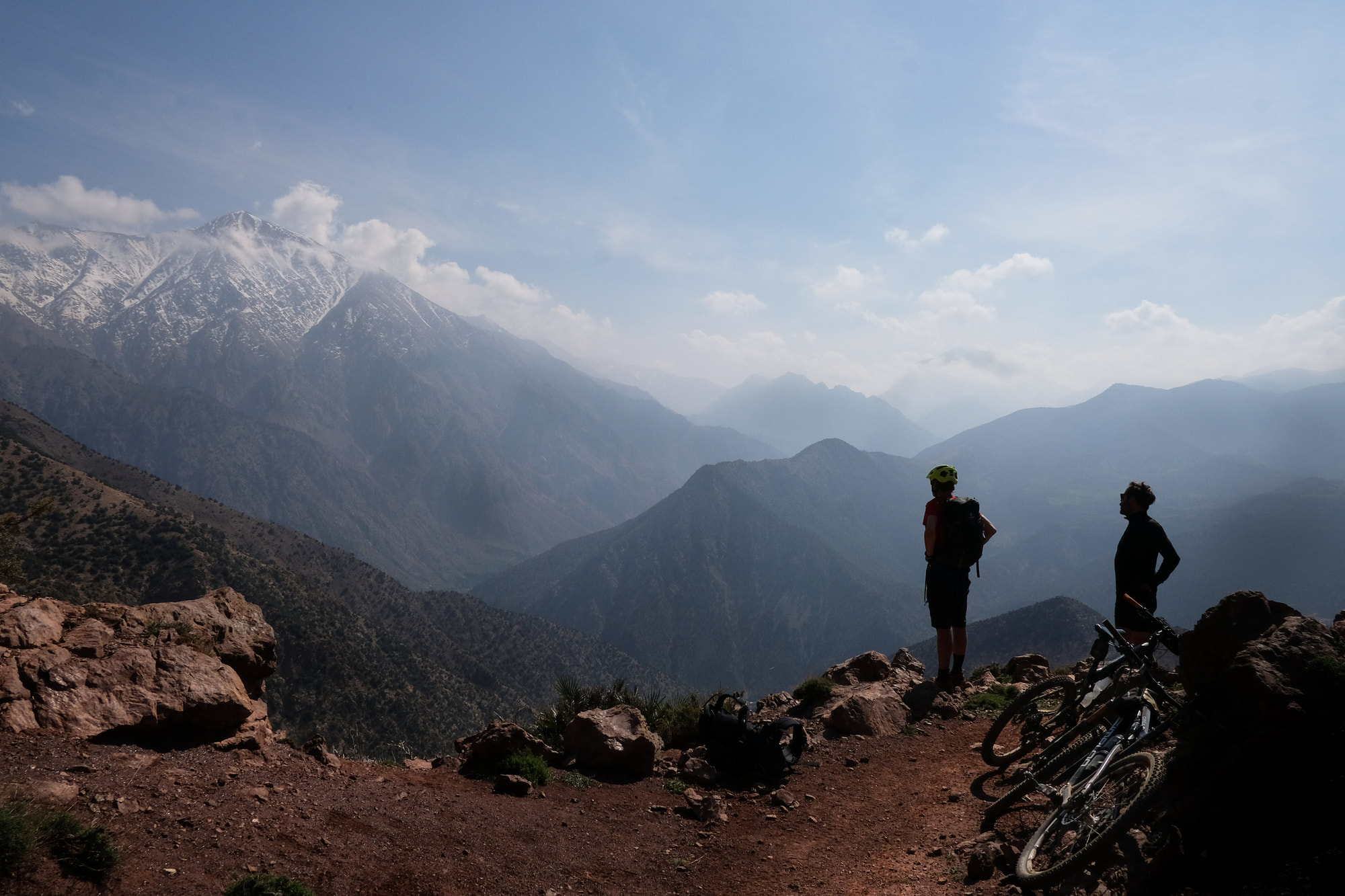
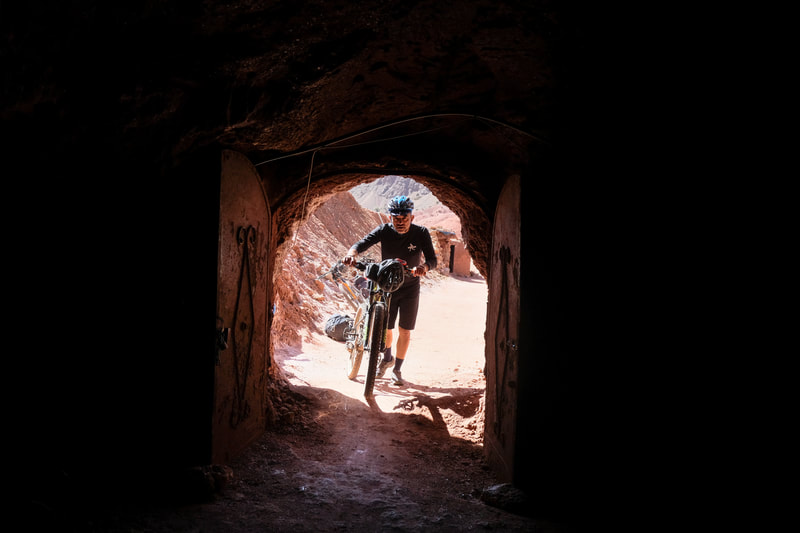
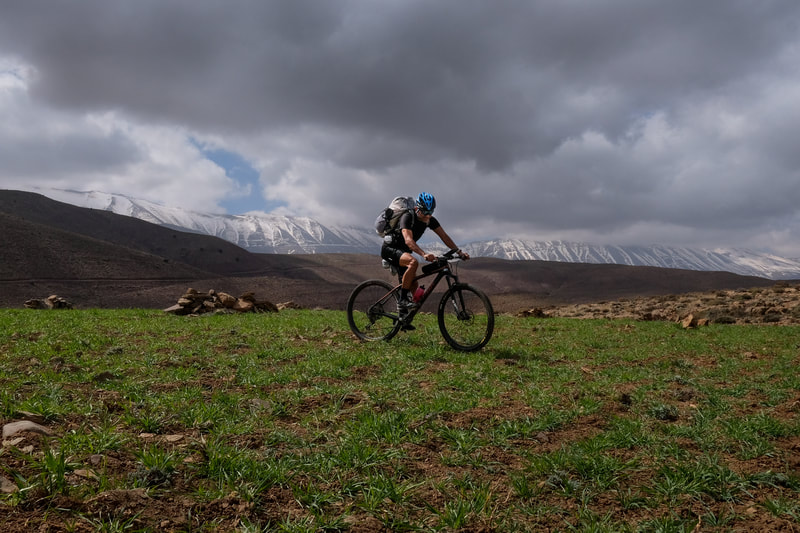
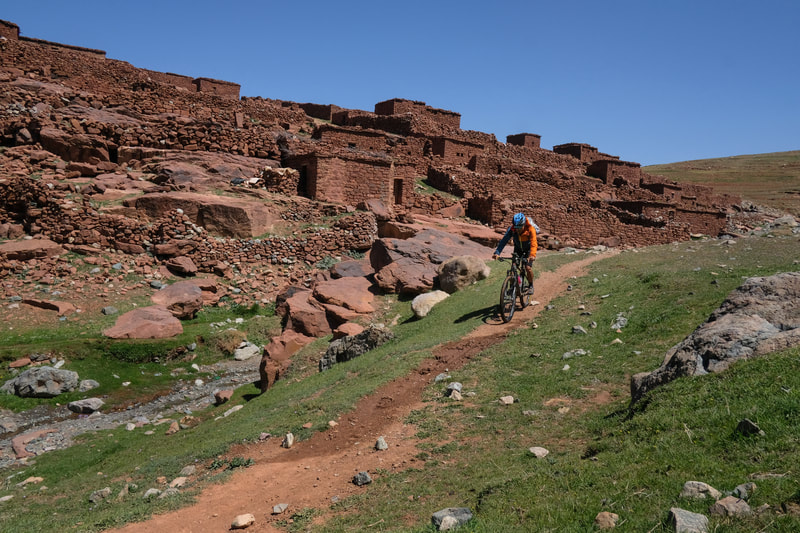
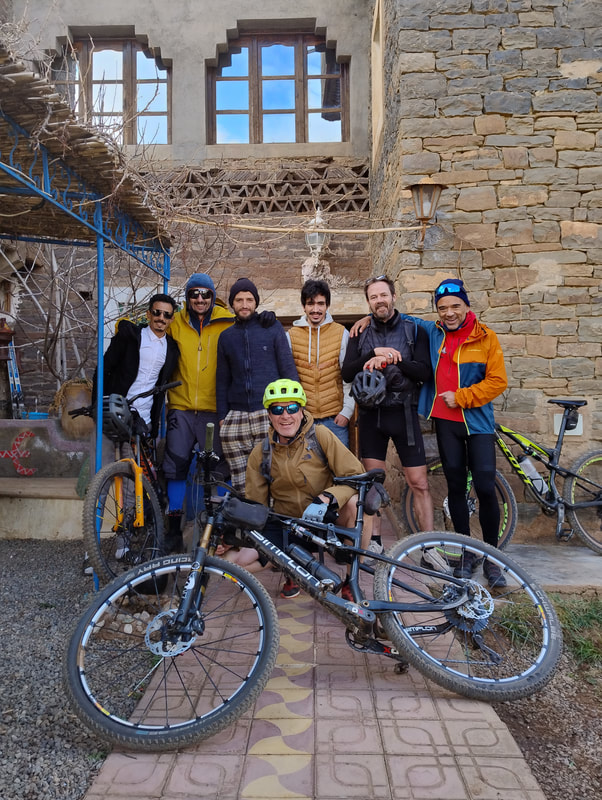
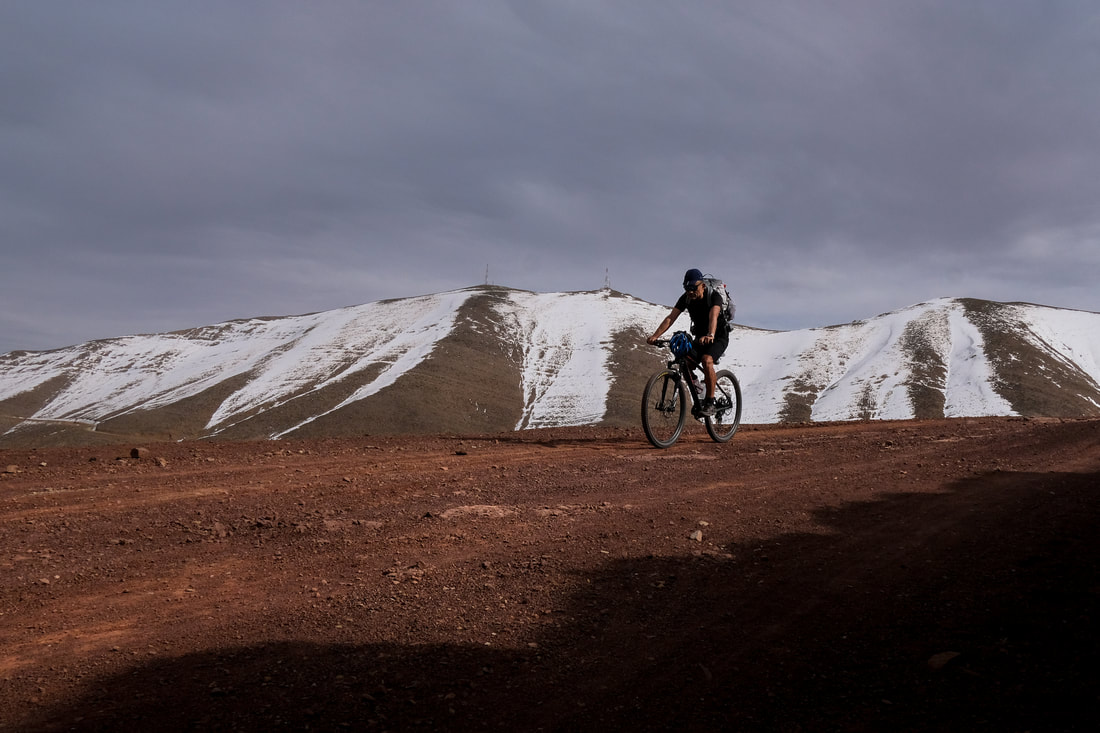
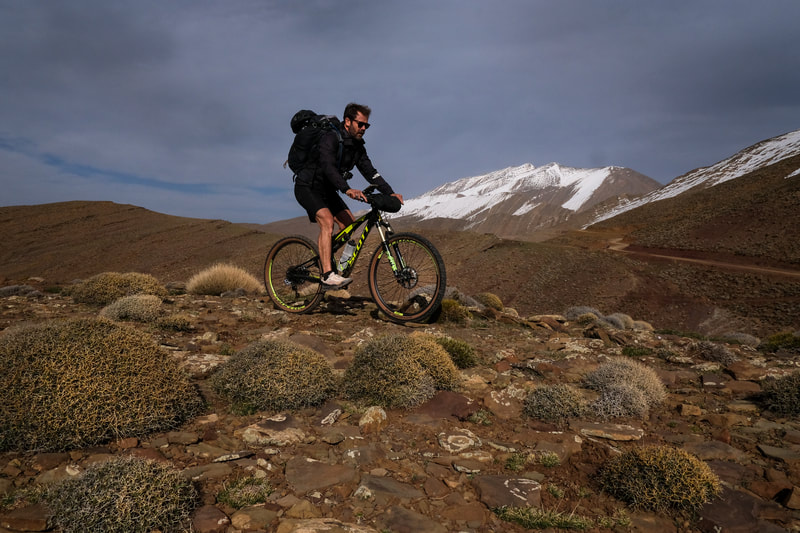
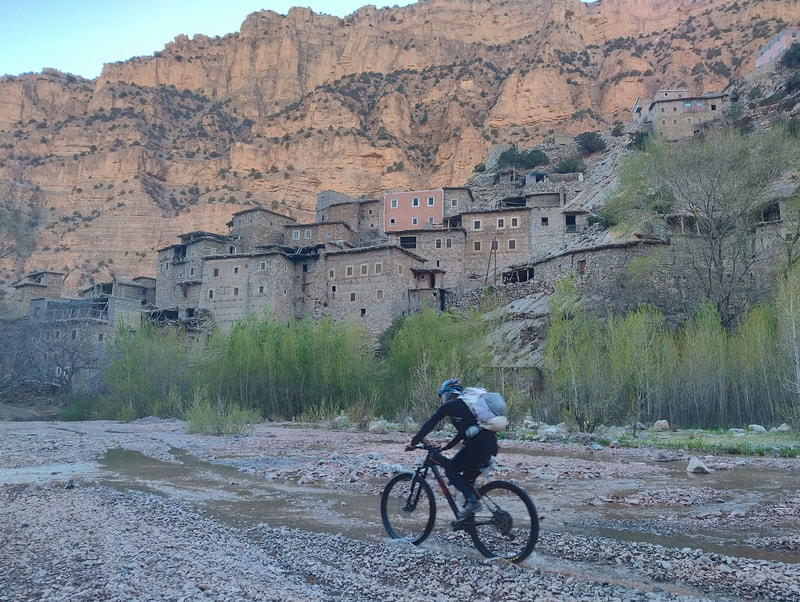
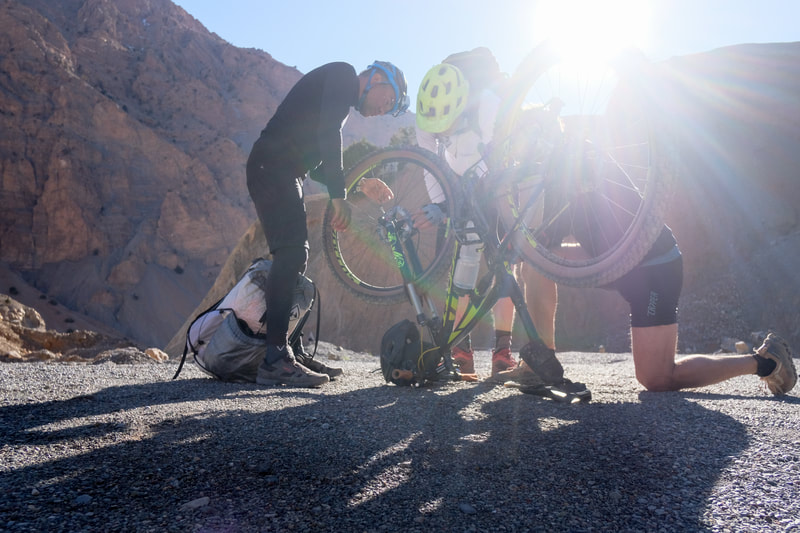
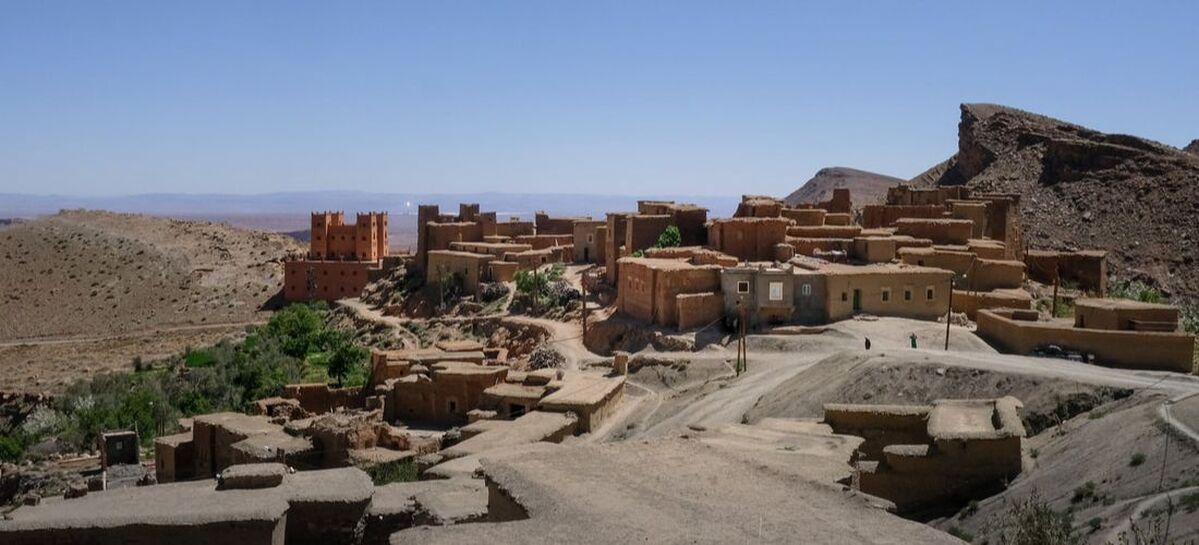
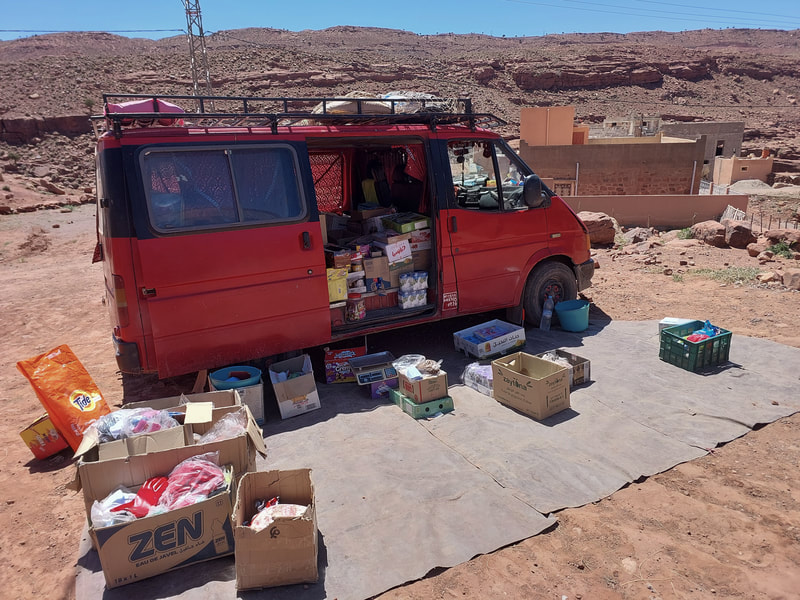
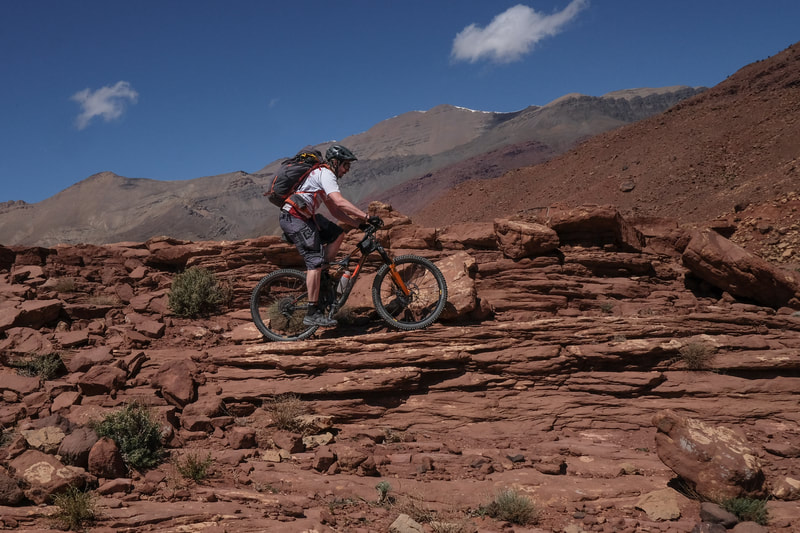
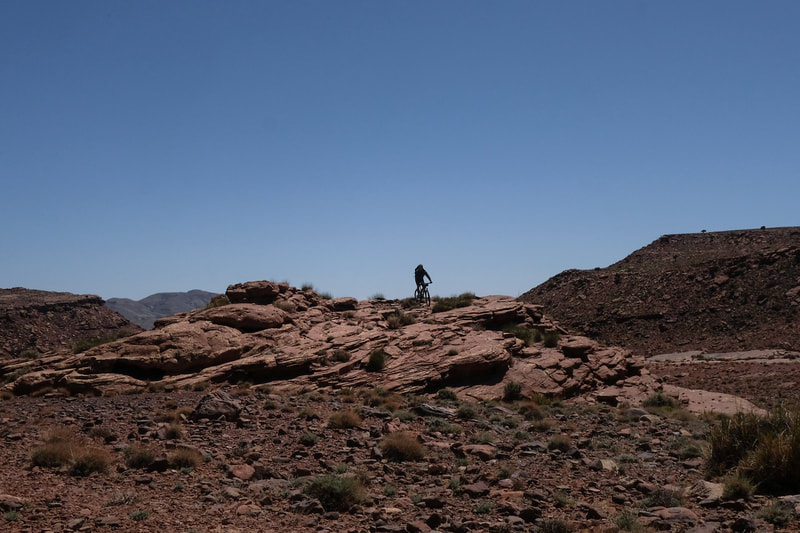
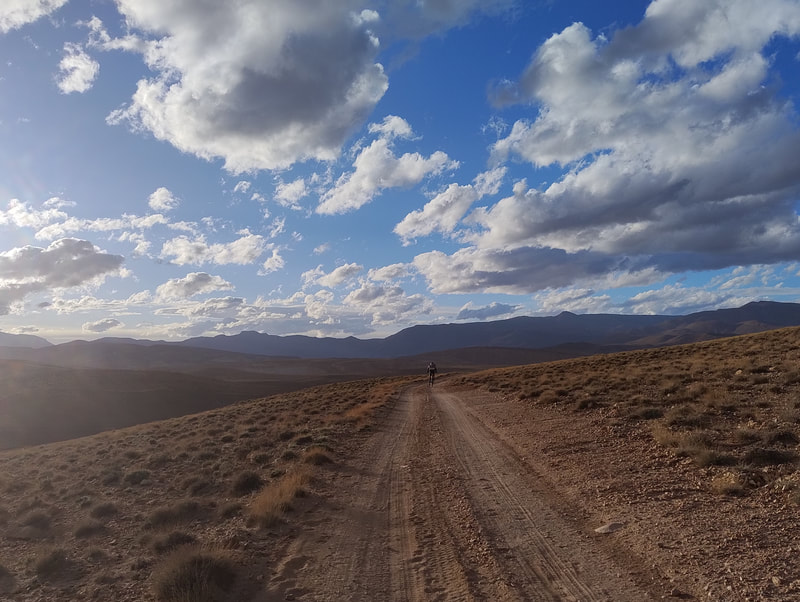
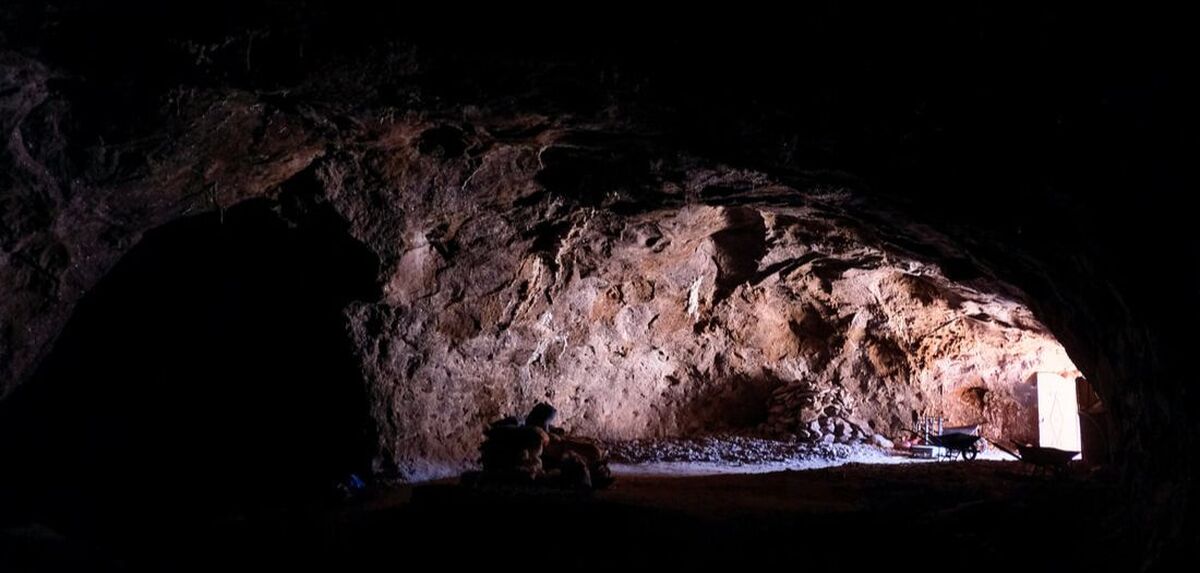
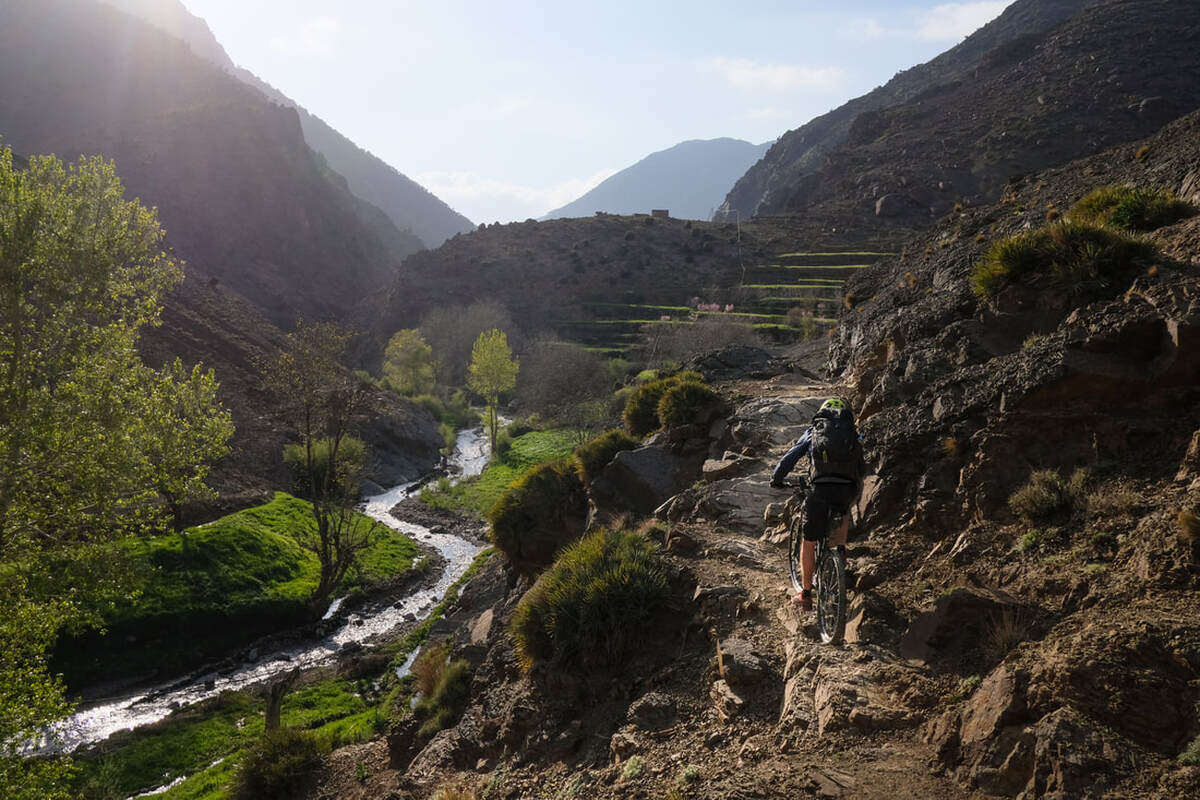
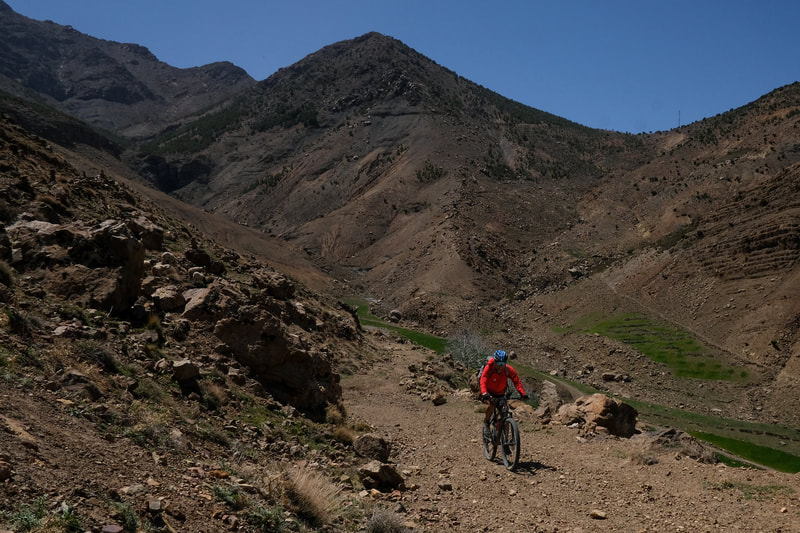
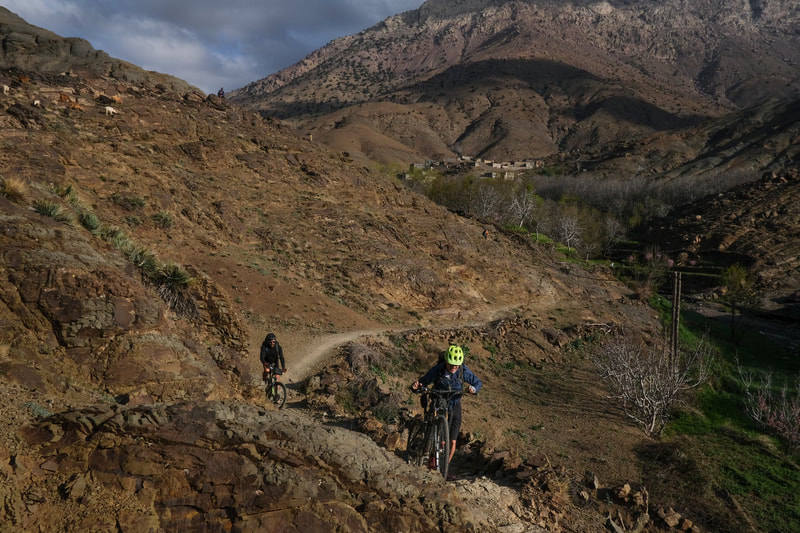
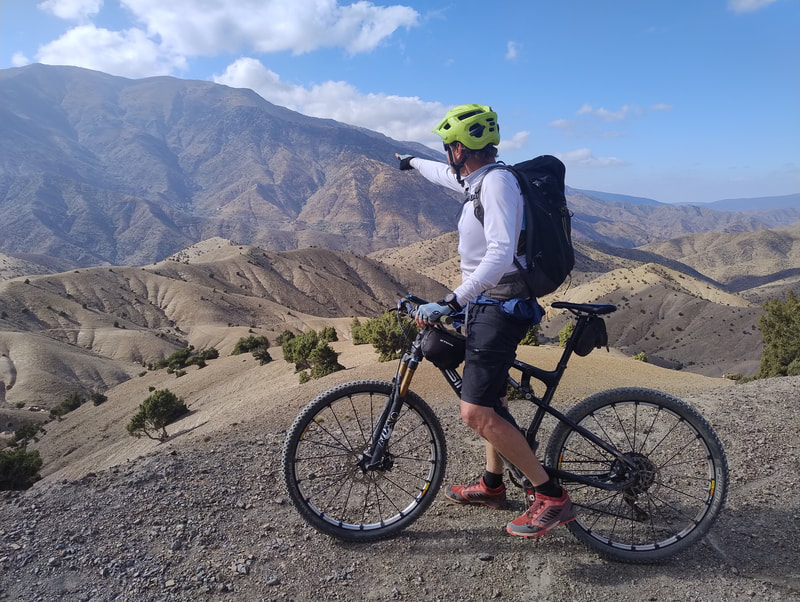
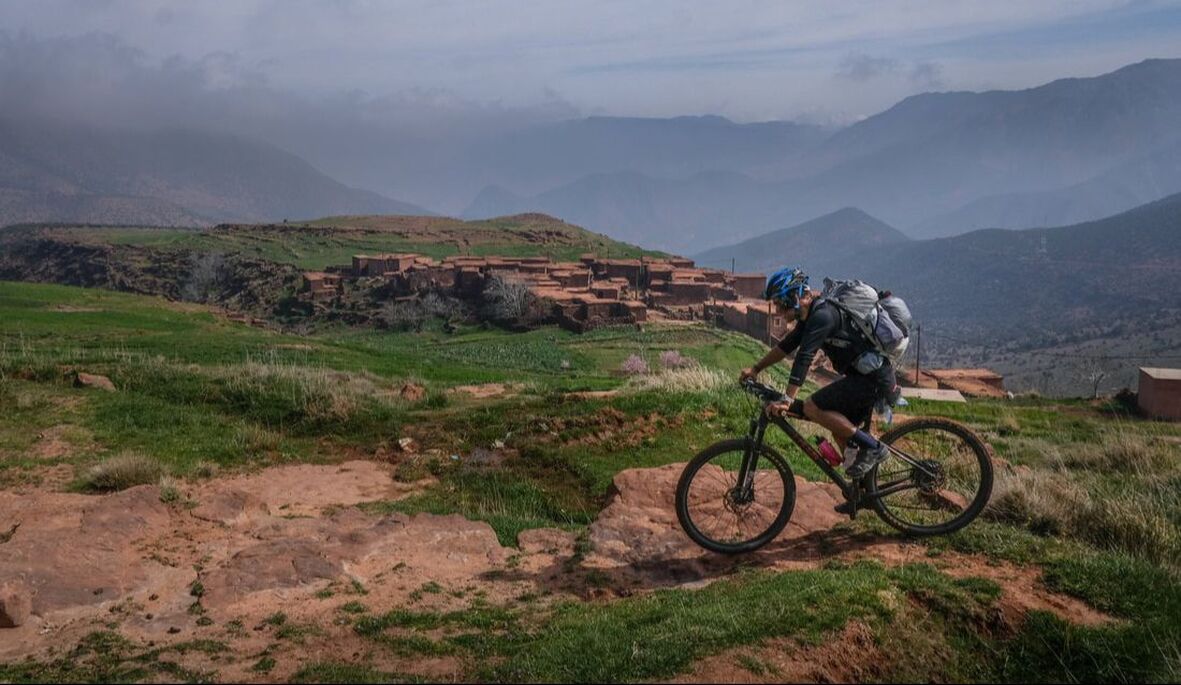
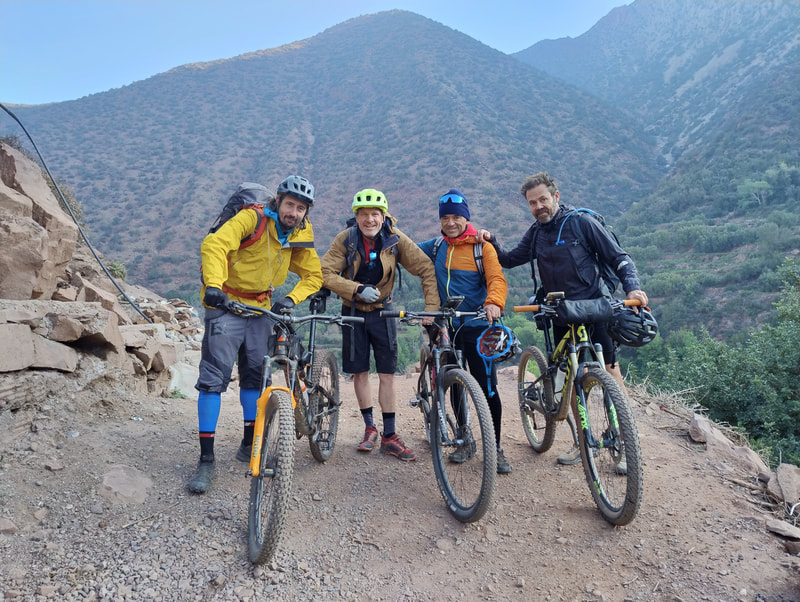
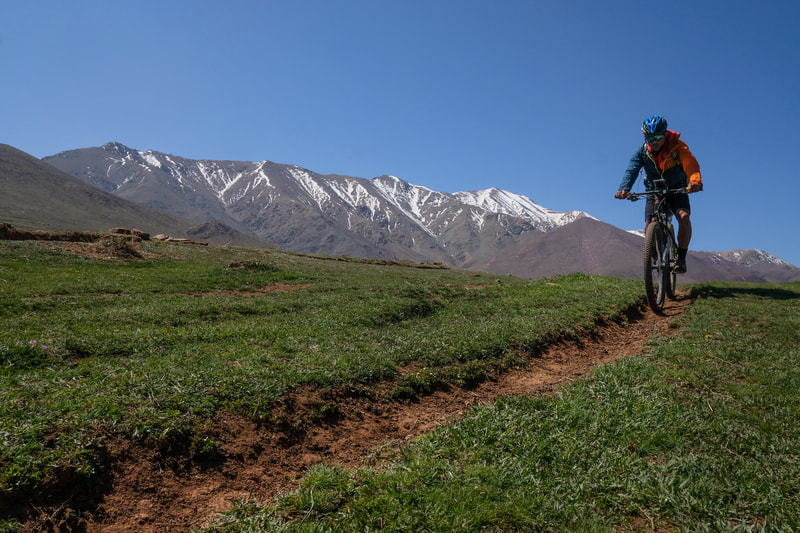
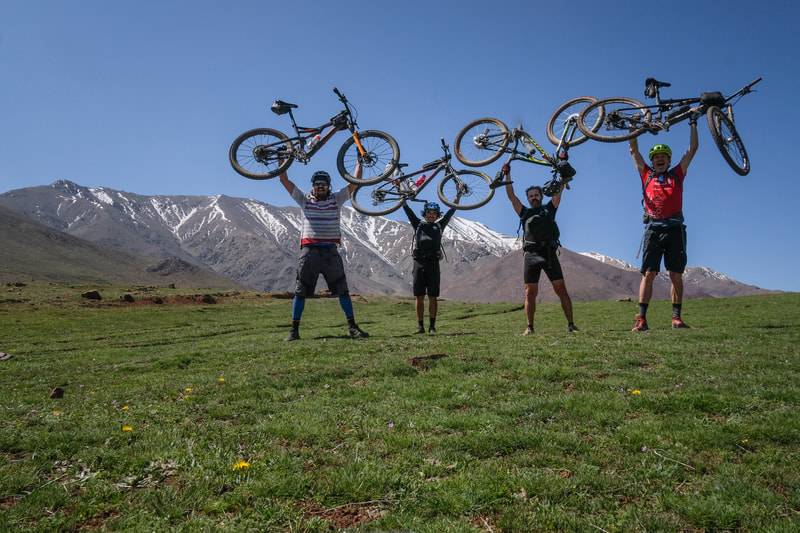
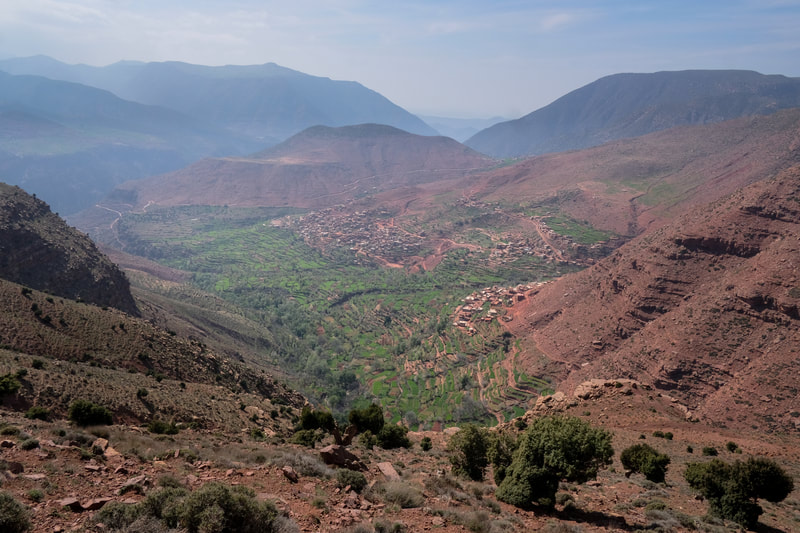
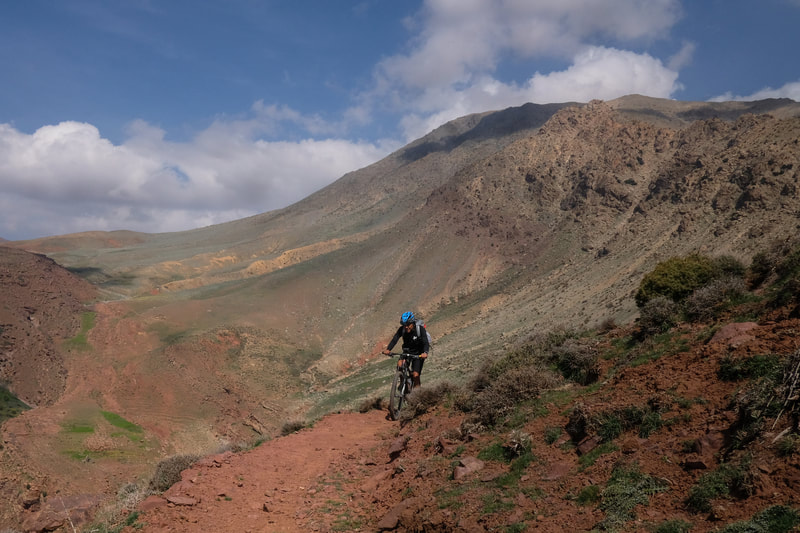
Kings of the Atlas is maybe one of the most iconic MTB crossings of the Atlas Mountains. Named after the two highest peaks of the mountain chain: Mt. Mgoun (4,071m) and Mt. Toubkal (4,160m) that both dominate the landscape and mark the start and the arrival of the 7 day east-west traverse.
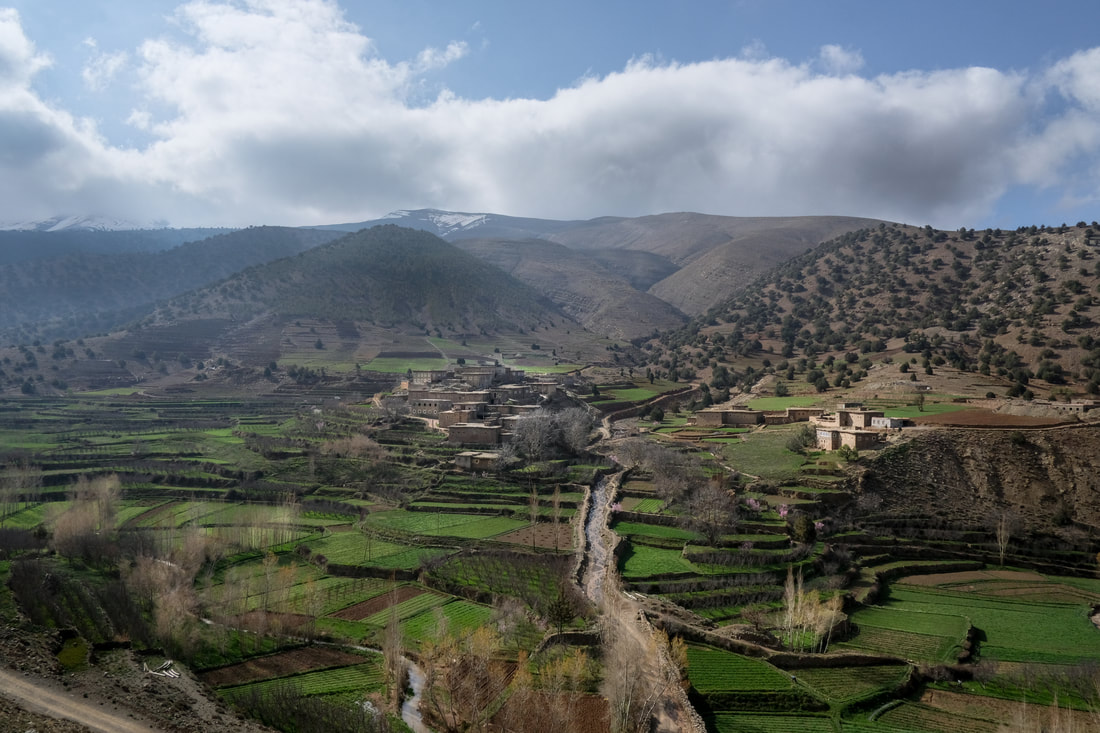
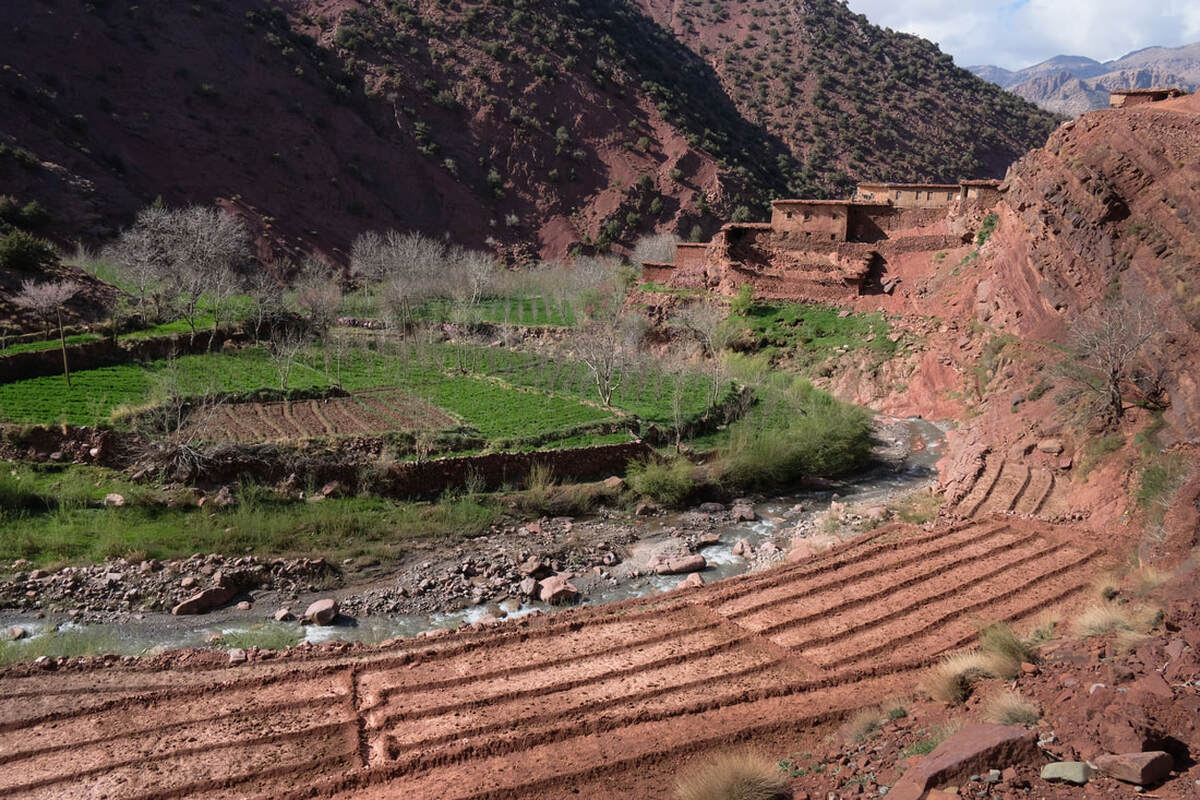
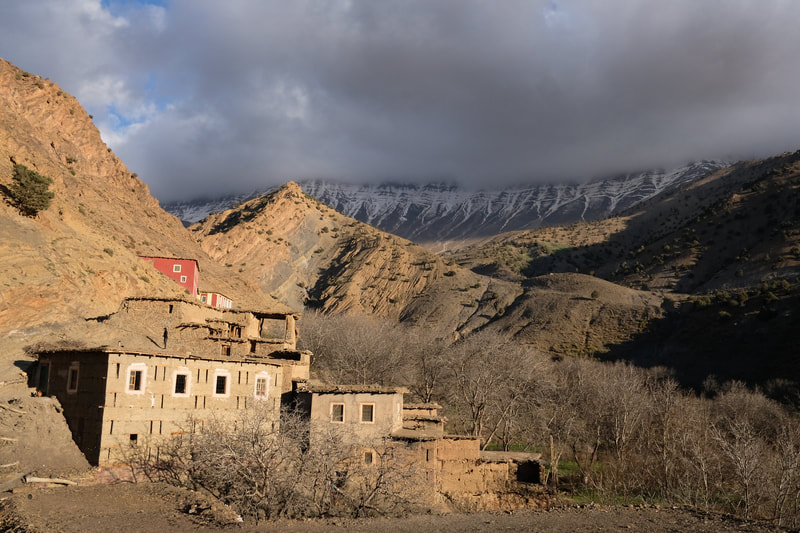
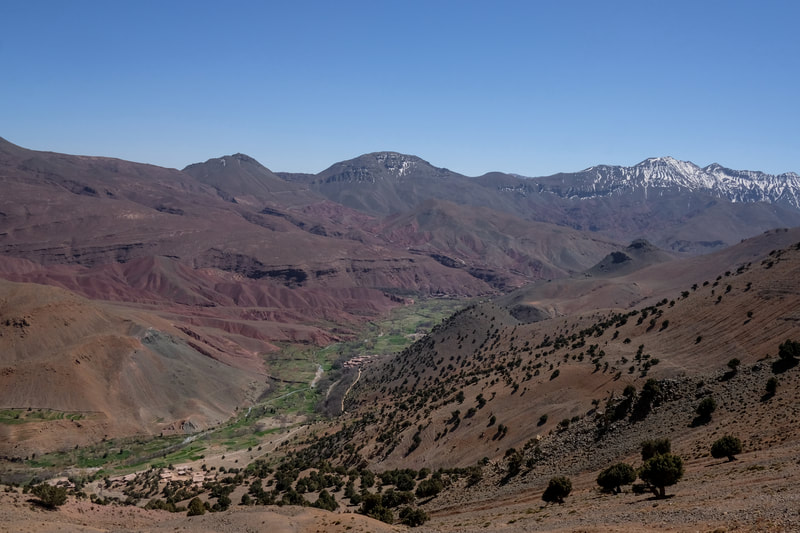
Starting in the shade of Mt. Mgoun, riding through the famous valley of Aït Bouguemez, the tour quickly dives into the geographical and spiritual heart of the Atlas mountains. The High Tessaout valley, which was until the 1920s only marked as “zone without information” on the maps of the French colonial power, kept until today a well hidden secret and veritable treasure of Amazigh culture.
The trail also connects the two most important water sources of the Atlas: the Tessaout and the Tensift river, carrying water all year long and source for century old irrigation systems, terraces and fortified collective granaries.
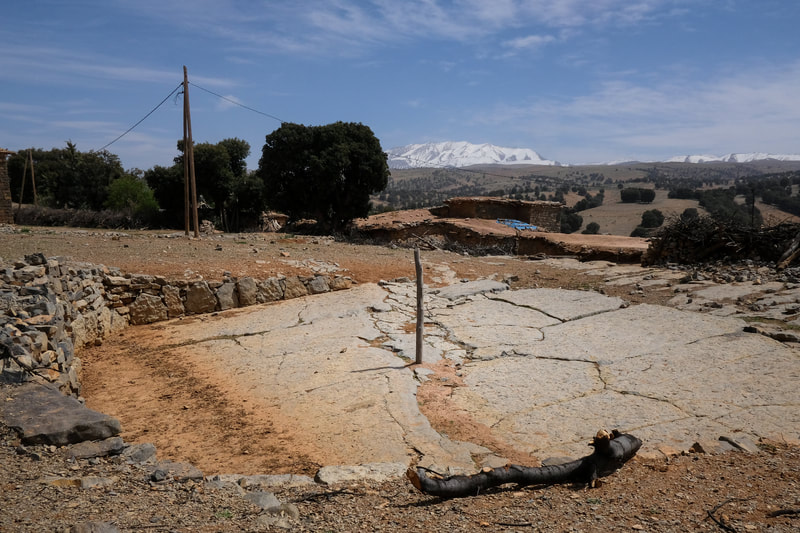
Further west, the valley of Anmiter provided the background for famous french painter Majorelle in the first half of the 20th century and marked for generations Morocco's image through his portrait of local architecture and customs. The Kasbah of the Glaoui or the salt mines in the city of Talouet tell a hundred stories of the more recent history of economic development and resistance during the late colonial period. The grand finale of the tour takes us over the high altitude plains of the Yagour Plateau, witness to ancient stone inscriptions and testimony to a high culture more than 2.000 years ago.
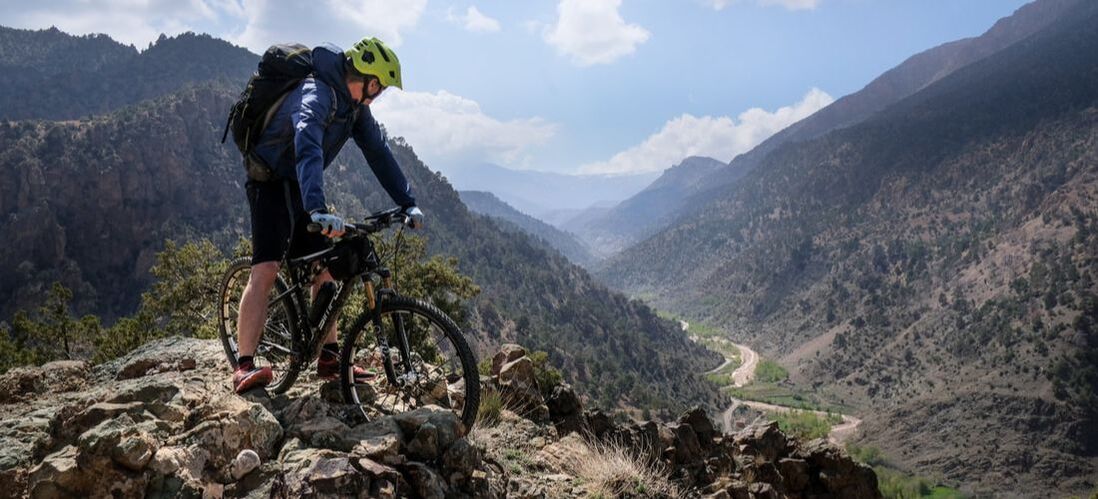
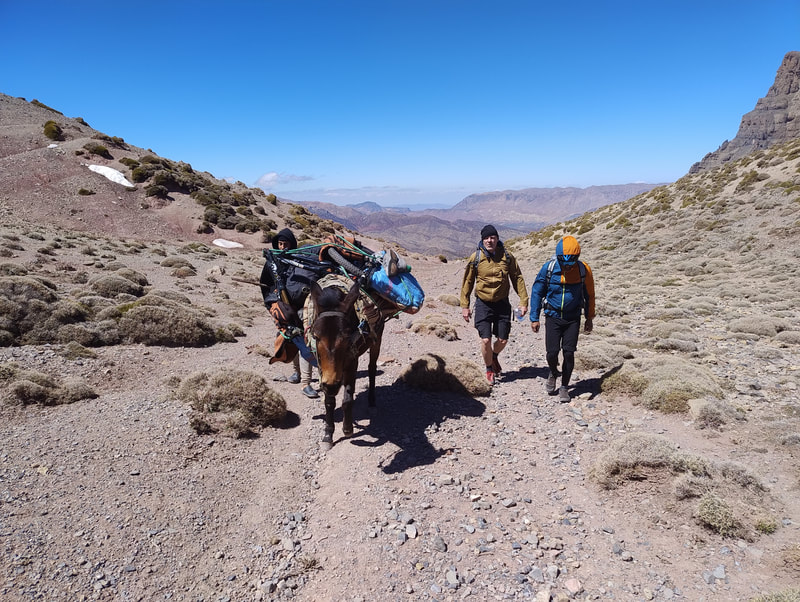
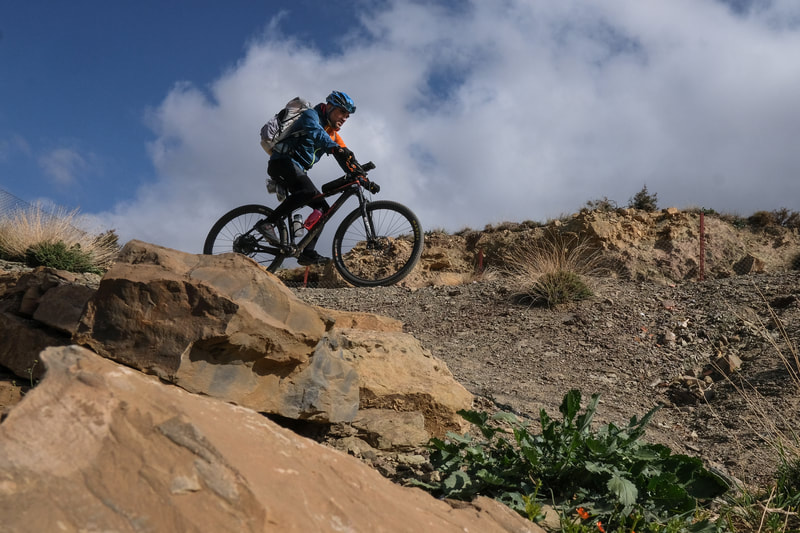
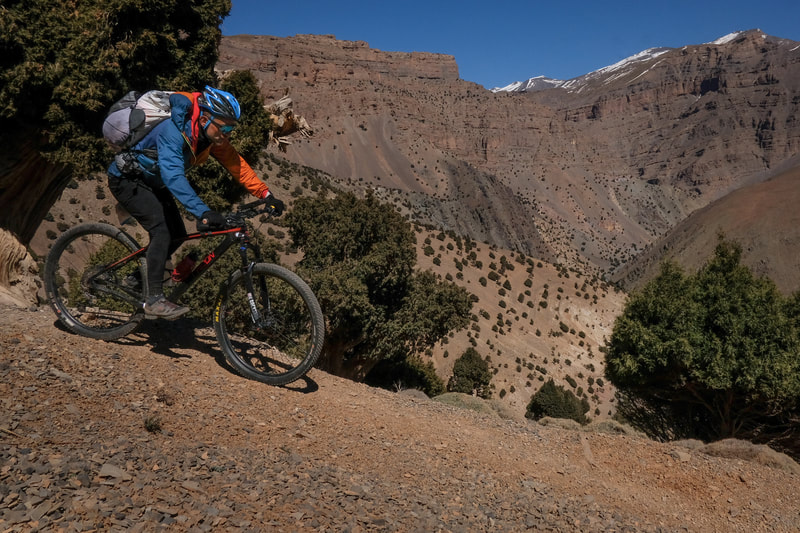
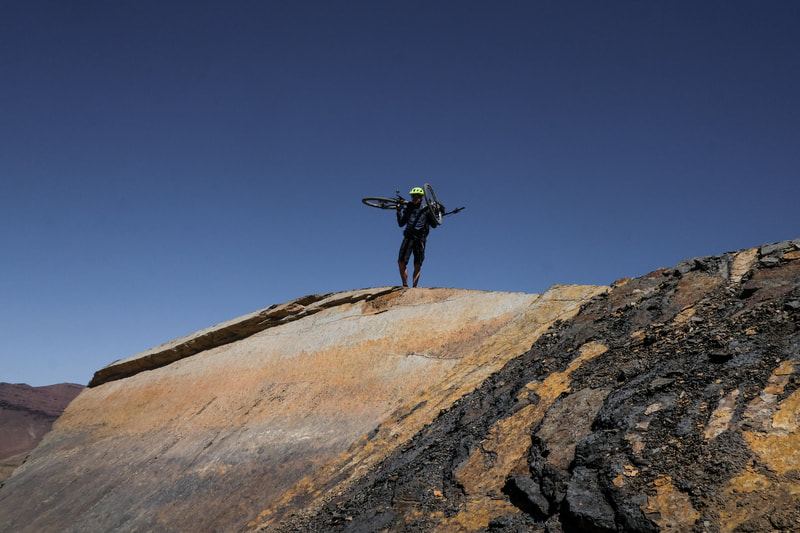
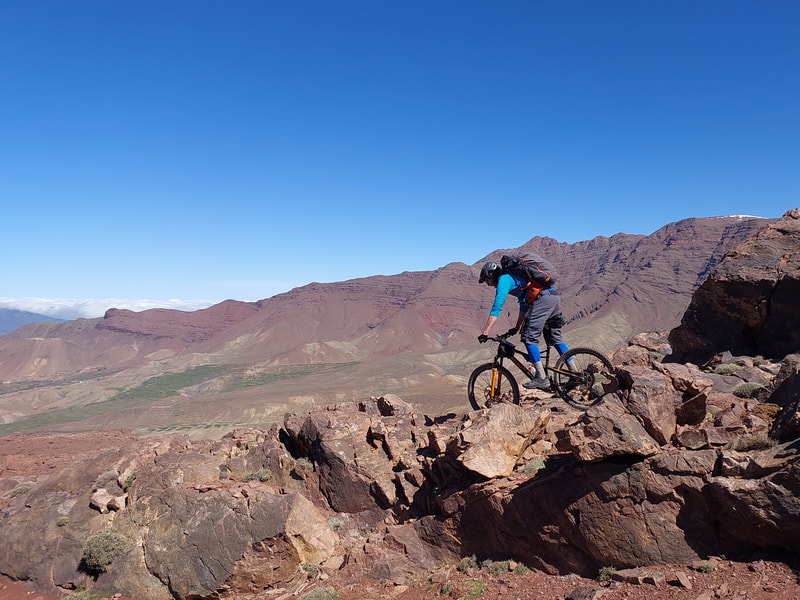
The Kings of the Atlas trail is a self supported MTB tour that can be completed in 5-7 days. It is mainly aimed at experienced mountain bikers with several technical and exposed single trails and hike and bike segments that require carrying your bike for several hours on at least two segments on day 3 and 6. Once we chartered mules to help us carry our bikes for the 11km hike up to the highest point of the tour, the Tizi n’Rouguelt pass at 3,000 metres.
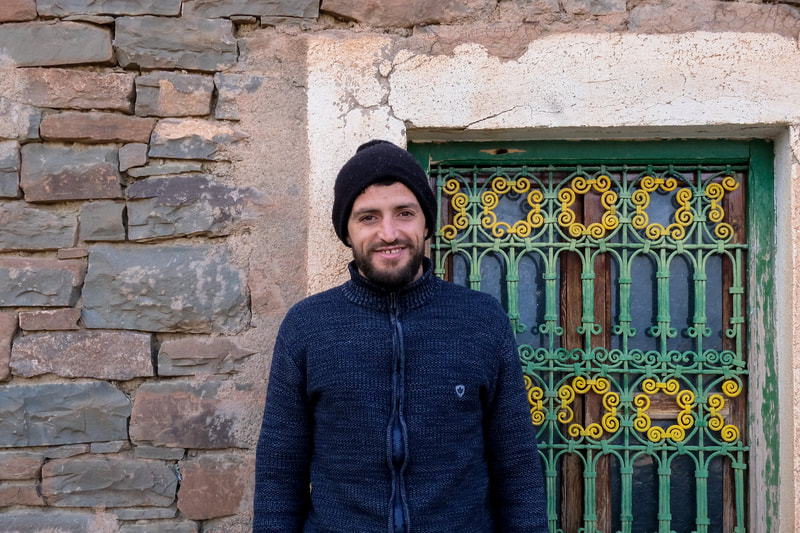
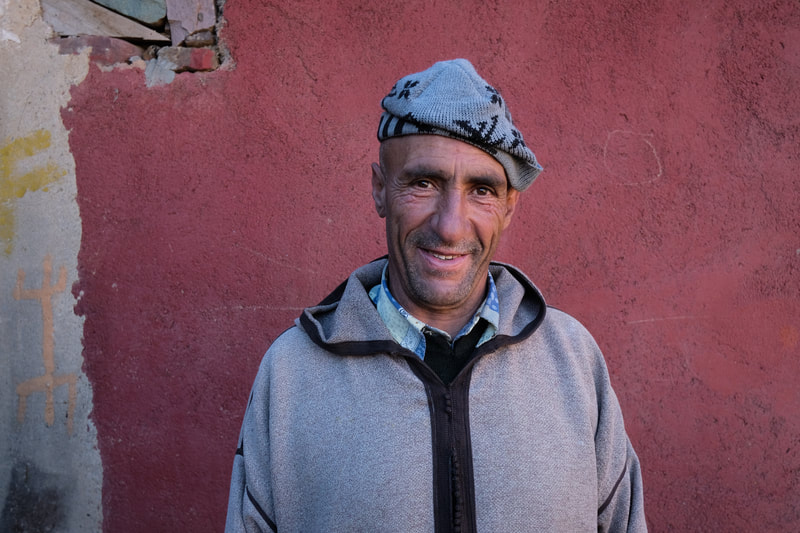
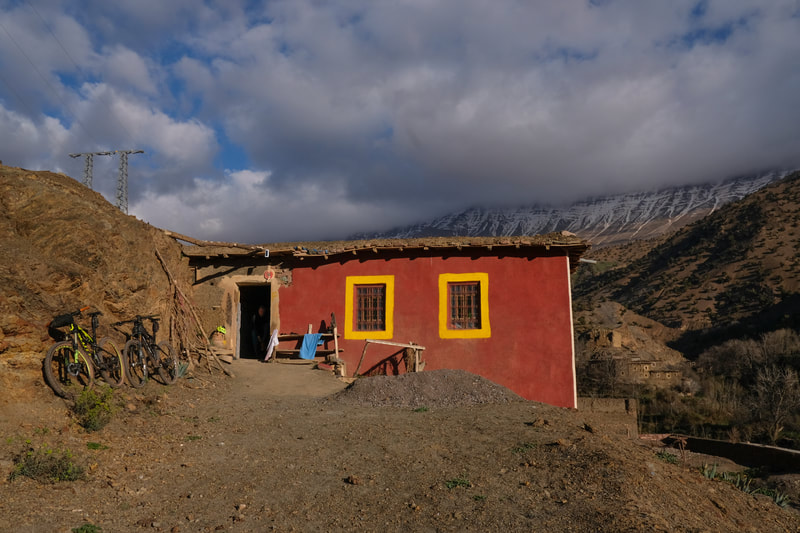
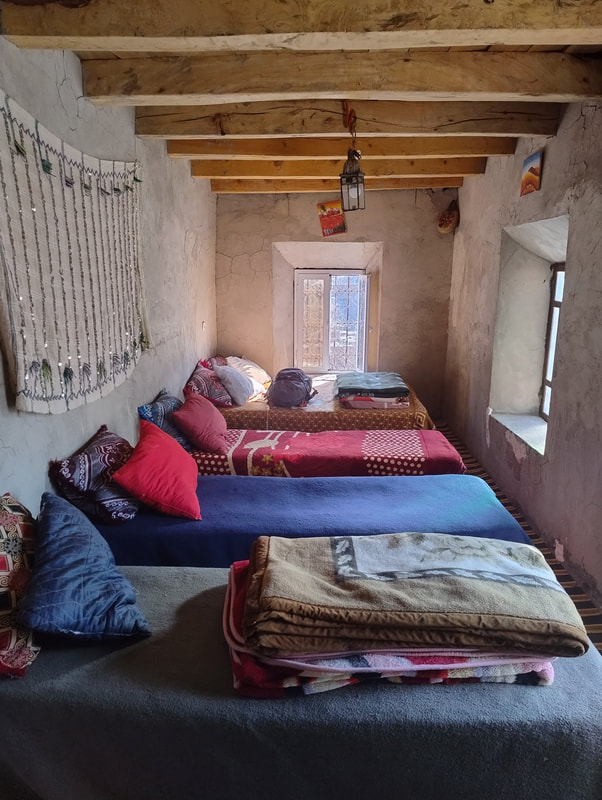
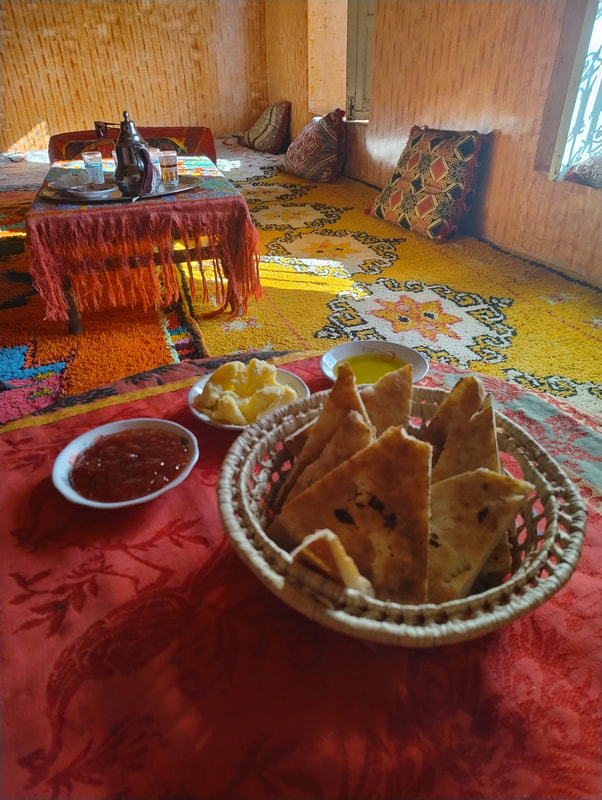
The further the trail delves in the High Atlas, the less we can rely on tourist infrastructure. This tour is no exception and we spend entire days without crossing other mountain travelers. While the well frequented valley of Ait Bougmez or Telouet are touristic hotspots with a large choice of accommodation, two nights of the tour we spent “Chez l’Habitant” - with a local family - we luckily found upon arrival. The reward is a warm welcome and a few mattresses put together in the living room or in one case, in the very basic annexe of the animal shelter did the job. The rudimentary circumstances and living conditions are quickly forgotten thanks to the incredible hospitality, authenticity and excellent food.
Overall, the Kings of the Atlas tour deserves its name and, compared to the other segments of the Atlas Mountain Trail, is distinguished by its spectacular high mountain landscapes and the quality of the many single trail segments. In only a few regions of the Atlas mountain range, the ancient high culture of the Amazigh is so apparent and present as in the valleys and plains of this tour.
Access and Logistics
Easy access to Azilal, around 3h from Marrakech or 4h from Casablanca. To Ait M’Hamed, count another 25minutes. From the Ourika valley a good hour drive brings you back to Marrakech. There are plenty of transport options. For bike transport, call locally based Omar (+212 662660447) who can put up to 10 bikes on his old Mercedes 500.
Phone and 4G connection is surprisingly good, almost throughout the whole trip. Even on the high plateau of Yagour we could mostly find a network.
Accommodation
Azilal or Ait M’Hamed (Departure)
Little mountain town with basic tourist facilities. We chose to sleep in Jaidate close to Marrakech and hired a driver to bring us to Ait M’Hamed and also to pick us up at the arrival. Dar Tanit is a lovely little resort which we can highly recommend. It has all facilities including a pool
Zawat Oulmzi Day 1
Gite Marabou located at the beginning of the valley of Ait Bougmez (Vallée Heureuse), this mountain hostel is made for bikers and hikers exploring the Mgoun area. Food is generous and all basic facilities available. Great view over the valley.
Roguelt Day 2
Gite Rogoult is a charming little mountain hostel with two large rooms fitting six mattresses each and one large living room. It is colourfully decorated with cosy carpets and pillows everywhere. The owner sleeps in the village and serves tea and food together with his wife and daughters. Tel +212 637378811
Ifoulou Day 3
Gite Ifoulou Tassaout fantastic mountain hostel right at the untamed waters of the Tessaout river. It is run by a member of the Altasmountain Community Mohamed Hanini and his wife. One of the tourism pioneers in the valley and in constant progress. Only very basic French, but rather good Spanish communication. Tel +212 668572781
Anmiter Day 4
:
We arrived at night and had a hard time finding a place to sleep. Luckily Mohamed from the Café Majorelle hosted us and served a wonderful Tagine. The place has several generous rooms with Majorelle posters and original photos on the walls. From the terrace you have a splendid view over the gardens and historic places of the village. Tel +212 653807787.
An alternative place in Anmiter is Chez el Yasid, Tel +212 639198700.
Telouet Day 5
We spent our recovery day in the Lion d’Or, a small hotel next to the famous Kasbah Glaoui. The managers are very friendly and service oriented. There is a small ‘penthouse’ apartment that fits four bikers which we can highly recommend.
Azgour Day 6
Azgour
is a small village on the river Zat with no official accommodation. The brothers Bougma and Brahim organise tracks and are used to host travelers in a very basic room sharing the house with the cows stable. The whole family of three generations welcomed us with a big smile to make our stay as comfortable as possible and served the best Tagine of the trip. Be aware of the simplicity of the living conditions when planning your trip. Tel Brahim: +212 668317555, Bougma +212 613541739.
Day by day
Day 1: Ait M’Hamed to Zawyat Oulmzy
Fitness/Endurance: Medium
Technicality: Low
This thrilling route from Aït M’Hamed (1,800m) to Zawyat Oulmzi (1,700m) takes you across one of Morocco’s most scenic high-altitude corridors, offering medium climbs, fast descents, and constant views of the Central High Atlas. A journey through landscapes carved by time and shaped by Amazigh tradition. An alternative starting point is the little town of Azilal, the provincial capital and easier to access with public transportation, adds a few kilometres to the leg.
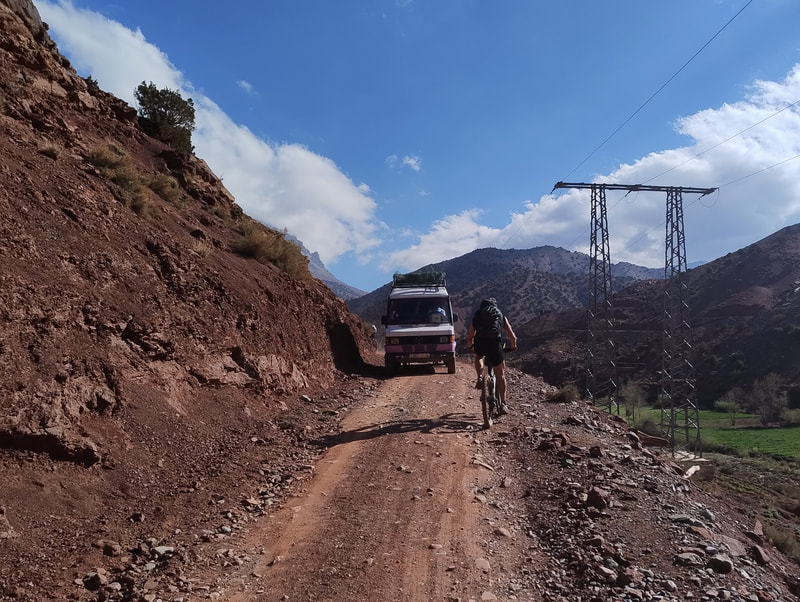
From Aït M’Hamed to the pass Tizi n’Aït Imi (2,900m) the route begins with a long uphill ride of 29 km on dirt road. Expect a few switchbacks and some steep segments, but all rideable until to the top. The Tizi n’Aït Imi is a wild, windy pass with jaw-dropping 360° views.
As the slopes were still partly covered in snow during our tour at the beginning of April, we decided not to go for the single trail option descending into the Aït Bouguemez Valley ("Vallée Heureuse") and stay on the main road instead. The regular road is a fun ride through terraced fields and walnut groves and Amazigh villages.
The last stretch across the valley to Zawyat Oulmzi is smooth and rolling, following the valley. The scenery remains stunning: ochre cliffs, snow-capped peaks in the distance, and warm welcomes in villages like Ikhf n’Ighir or Timit before reaching Zawyat Oulmzi.
Highlights and challenges
Relatively easy day to start the tour and the only challenge was to get rusty knees back in motion. Crossing the windy Tizi n’Aït Imi with the stunning views to the Mgoun was definitely the highlight of the day.
Day 2: Zawyat Oulmzi to Rouguelt
Fitness/Endurance: Medium Technicality: Low
This leg is a bit longer than the first day, but also rather easy, rolling through scenic landscapes of the Ait Bouguemez valley in the shadow of the Mt. Mgoun. Until the village of Ifrane the trail follows the river, meandering through lush orchards and terraced fields. This section offers a gentle ride, with possibilities to join the road, where water, mud or vegetation take over. In Ifrane, chose the path towards the foothills of Jbel Rbat leaving the busy valley. The panoramic views of the surrounding valleys and peaks are the reward for the 5km climb.
Descending from Jbel Rbat, the trail leads again in the Aït Bouguemez valley, into the flowering apple and walnut plantations until eventually arriving in the small town of Tabant, the capital of the valley and a good place to gear up on water and other supplies before leaving the Vallée Heureuse. At km32 we cross the Assif Boughemez river and follow the breathtaking Oued Lakhdar (Green River) upstream. The final leg from Aït Bouguemez to Rouguelt is a 15km gentle climb of 400m elevation on a small dirt road winding up the mountains through serene villages while the valley is getting narrower. Rouguelt (or Ghougoult) and Tiziatine, on the opposite side of the river mark the end of the road.
Highlights and challenges
No major challenges in terms of endurance nor technicalities. The trails through the orchards are partly tricky, but never steep or exposed.
The trails through the Ait Boughemez valley are an oasis and highlight of the tour. Reminding us of the fictional Shire land of the Hobbits, with the generous spring vegetation and the abundant water everywhere. Take your time when you ride through his scenery and plan for a picnic somewhere around the Sidi Moussa hill.
Day 3: Rouguelt to Ifoulou
Fitness/Endurance: High Technicality: High
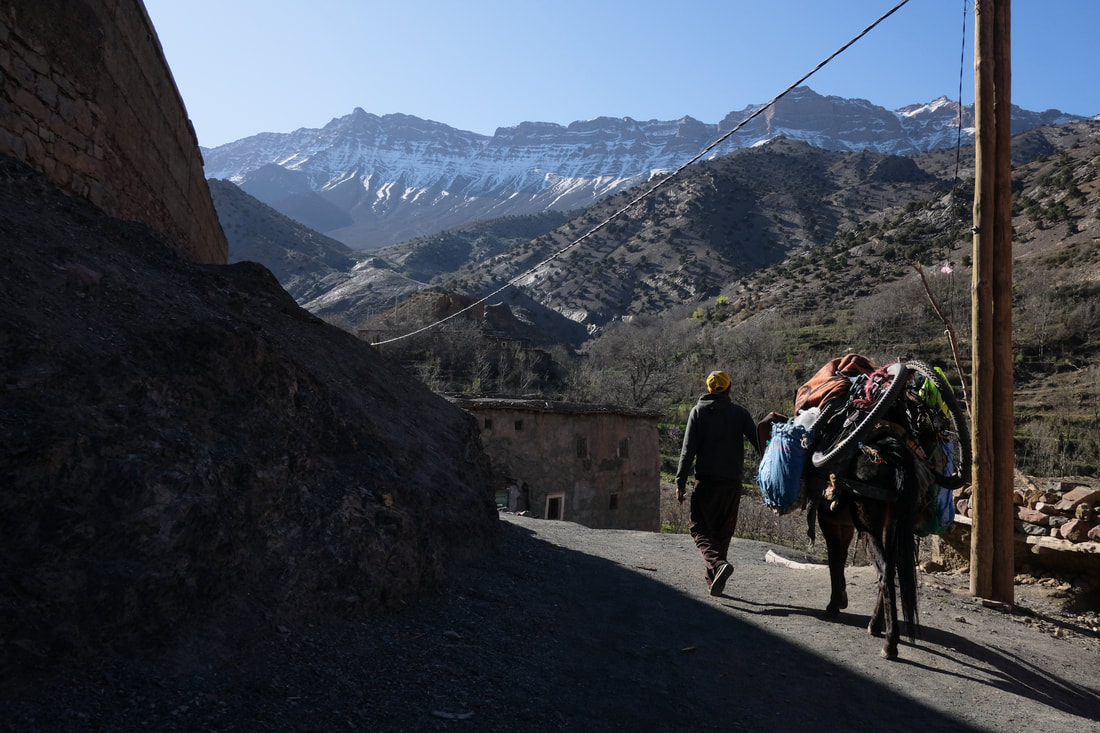
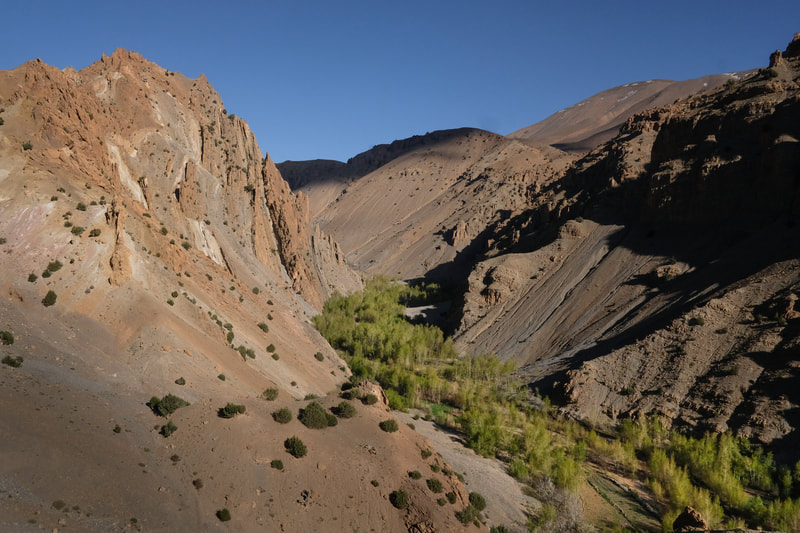
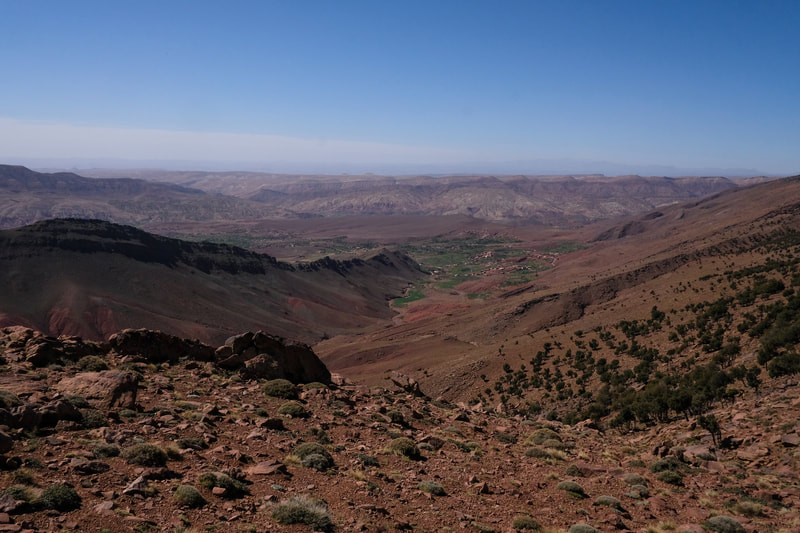
This is the first challenging day of the tour and leads you deep in the heart of mountains, off the beaten trails. Starting in Tiziatine/Rouguelt, we chartered two mules to carry our bikes the 11km hike up to the Tizi n’Rouguelt pass at almost 3,000 metres altitude. The path follows the beautiful river Assif n Tifira, which at this time of the year was a powerful creek with rapids and smaller waterfalls. The ascent took us about four hours but it is worth the hike. The landscape gradually became more rocky and arid. The view from the pass offers breathtaking views into the High Tessaout Valley, one of the most important water streams of the central Atlas. From the descent you can spot the well visible mountain road from Amezri crossing Tizi n’Oulaoun (2,767m), which is part of the Atlas Mountain Trail segment “Central Atlas Crossing” (Day3).
The descent to the village of Tasgawait is a playground for downhill fans. About 4km of demanding single trails with a mix of rocky and playful passages and fully rideable for experienced mountain bikers. You will enjoy surfing alongside sandy hills and natural slalom slides. Tasgawait is a busy mountain village with a large market. In spring hundreds of small lambs and goats are being transported here to be grazed on the high mountain pastures.
After Tasgawait the descent continues softly on a gravel road, reaching Amezri where we join the Atlas Mountain Trail “Central Atlas” and follow the same trail in the opposite direction along the riverbed of the Tassaout for some 30 km. Following the Tessaout downstream, the mainly paved road rolls gently through the villages of Imi n’Ikis and Ichbaken. In Ishbaken we take the newly built and oversized road that climbs steeply up the canyon, providing scenic views on the valley before descending again to Ait Hamza. You can also choose to stay in the Tessaout river bed, but depending on the season and water level expect wet shoes and uncountable crossings. From Ait Ali n’Ito the road continues on asphalt. If you still have some juice left and enough time, consider a quick detour to visit the breathtaking village of Magdaz, crossing the river and climbing up the road for 4 km. If you stay on track, follow the main road for another 6 km downstream on the paved road, passing Fakhour and finally arriving at our destination of the day, Ifoulou.
Highlights and challenges
The highlight of the day is without any doubt the pass of Rouguelt at 3,000m altitude after several hours of hiking in breathtaking canyon landscapes as well as the single trail downhill ride to Tasgawait.
The High Tessaout valley with some of the best preserved Amazigh architecture and the path through the “Grand Canyon style” landscape is another unforgettable segment of the Atlas Mountain Trail.
Day 4: Ifoulou to Anmiter
Fitness/Endurance: High Technicality: High
Be prepared for a long day with radical changes in landscapes and temperatures. From Ifoulou we follow the Tassaout river downhill until we reach the N23 in Aît Alla, where we turn left. This road connects Ouarzarzate and Demnate, crossing the main Atlas mountain chain. Luckily there is almost no traffic and you can concentrate on the riding and changing landscape. The first 15km uphill are a great warmup until reaching the Tizi n’Fadghat pass at 2,232m in the shade of the Jbel Toudja. From there enjoy the windy road rolling down south through a landscape of stones in all shades of ochre. Don’t miss the turn to the right (km24) on a sandy road, towards the village of Tighuerte n’Igwane which is worth a stop. Take the road along the school that contrasts the soft landscape with flashy colours. On the next hill you’ll spot the Noor Solar Plant in the southern plains of Ouarzazate. From far, it looks like a UFO that just landed in the Sahara desert.
The next village on the route Taliouine implies a small detour, absolutely worth it. It feels like a desert town, although still at 2,000m altitude with beautiful Amazigh architecture. Except for a modern and surprisingly well maintained palace that towers over the village, time has stood still here. The lush oasis surrounding the village and tree plantations are a great picnic spot.
From Taliouine the road takes us in a dry desertic nomansland. Don’t miss the turn to the right at km47, the lowest point of today's tour (1,600m). At km54 you’ll cross a tiny village with a beautiful oasis, followed by two nasty climbs on a rocky and sandy road before reaching a savannah type plateau with outstanding views. Finally a short and neck breaking serpentine road brings you to the river bed of the Oued Ounila through which you reach today’s destination in Anmitar, a busy town surrounded with green gardens and plantation, famous through the paintings of french painter Majorelle who lived in the Oasis in the early 20th century.
Highlights and challenges
The tour is overwhelming all the way through the contrast of landscapes and forgotten villages that are a time travel to the past. There are no major technical challenges, the climate is very dry and the gravel roads are in parts rocky or sandy. We had to fight against heavy head winds at times. Bring enough water and refill whenever possible.
Day 5: Anmiter to Telouet (Rest Day)
Fitness/Endurance: Low Technicality: Low
Following the endurance ride and a long and tiring search for accommodation in Anmiter at night, we decided on a rest day, with just 14km on the provincial road P1506 to Telouet. Enough to warm up the muscles and enjoy the colourful but arid landscape leading back to the Central Atlas high plains. We are back on a well frequented axe of the High Atlas as the road connects the Tizi-n-TischkaPass with the famous Unesco World Heritage Site Ait Ben Haddou.
On the Tizi m’Tanbdout (1,960m) we have reached the highest point of today's little tour. Just before the pass (km4) a small path on the right hand side of the road leads into a narrow canyon to the salt mines of Telouet, worth the detour. The mine is still being exploited and the guardian is happy to show you around for a small contribution. The exploitation today is done with small dynamite explosions. Inside the mine, several pools in different colours and shapes reveal impressive salt crystals. The mine lies along the old caravan route Marrakech-Ouarzazate and in its high times local jewish families were given the concessions to exploit salt and trade the valuable resource.
The small town Telouet lies in a vast high mountain valley at 1,800 meters and is a busy hub for local trade and tourism. Quite a contrast after the last days deep in the mountains. You’ll find all the amenities for a rest day such as restaurants, souvenirs and grocery shops.
The Kasbah of the Glaoui has been closed to the public since the earthquake of 2023 but if you insist you might be lucky and find the gatekeeper at the Léon d’Or Atlas Hotel opposite of the Kasbah. He will be happy to show you around and share the history of this jewel of Amazigh heritage.
Day 6: Telouet to Azgour
Fitness/Endurance: High Technicality: High
Leave the provincial road in the centre of Telouet, direction Timjoujte (4km). The smooth uphill ride is a nice warm-up until the village at the foot of Tizi’n’Telouet. The pass and first big challenge of the day is already well visible from Telouet, clearly marked by the electric power poles. Shortly after the village the single trail starts on a steep climb that will force you to hike and carry your bike most of the way until the pass of Tizi’n’Telouet (2,600m). The views from the pass are breathtaking and we are looking into the valley that feeds the spring of the Tensift river, the main water source for Marrakech and one of the most important water sources of the Atlas with a total length of 260 km until reaching the Atlantic Ocean between Essaouira and Safi.
An overdimensioned road has been carved in the mountain from the north side of the pass and winds down through uncountable serpentines. Take your time enjoying this bizarre downhill. At some points the old mule trail is crossing the new road and you have the choice between the road and some remaining bits of a very steep single trail.
We are leaving the main road sharp left on km20 towards the west, crossing the Tensift river and passing through the little village of Titdri (1,800m). From there the rocky road climbs steeply through terraces as well as juniper and pine forests until a beautiful mountain pass at 2,100m. Great spot for a picnic.From here the trail leads 500m downhill to the Tizi-n-Tichka Road RN9 where you find a couple of tourist shops and cafés ideal to fill provisions of food and water.
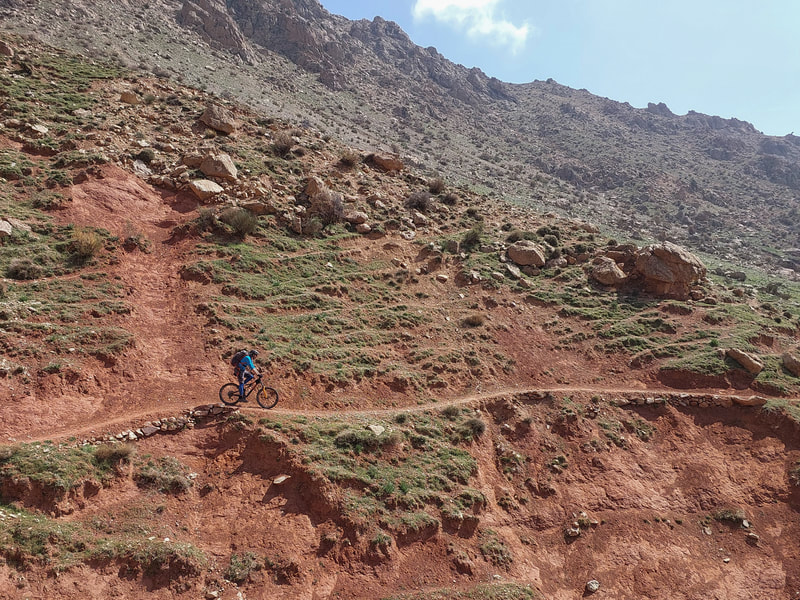
Take the Tishka road south for about 1km before turning right, steep uphill on a dirt road (km 33,7). This is the last climb of the day of about 300 height metres without major challenges. Don't be tricked, the tour is far from done. The remaining 13km downhill are one of the highlights of the tour but include several very technical and steep passages that will need full concentration. After 3km the main road crosses the river, but instead of taking the bridge you have to follow a small single trail just before the bridge, following the river on the right side. Several passages are very exposed and trail finding can be difficult. After only one kilometer on the single trail, the way marked on the map was overgrown by vegetation and we found a mule path that mounts on the right mountain flank and then steep down back to the river and eventually crossing the river on the left hand side (km43,5). What comes now is one of the best single trail rides of the Atlas Mountain Trail. A mix of fast flow trail and technical passages, often quite exposed with breathtaking views and quickly changing up and down stretches.
From the village of Açat (or Assads) a gravel road leads through a beautiful narrow canyon, rolling down the last few kilometers to the final destination Azgour in the Oued Zat Valley. Entering the village the kids will welcome you already at the bridge and show you the way to the house of Boujma and Brahim, where we spend the night.
Highlights and challenges
The different views you will catch into the rugged valley of Tensift river are one of the scenic highlights of the tour. We didn’t find the precise location of the source of the prestigious water stream, but the landscape of steep, wild and rocky slopes, the first lush green terraces is a very special memory and made us think of all the ecosystems and human activities this small creek will yet support before it reaches the ocean.
Another amazing highlight is undoubtedly the last downhill trail to the village of Assads that provides everything we are expecting from a world class single trail. Keep a bit of energy for this last segment of a long day, you will need it.
Day 7: Azgour to Setti Fatma
Fitness/Endurance: Low Technicality: Low
The last day of the tour leads you over the plateau Yagour, famous for its ancient stone carvings and high altitude pastures in the shade of the holy Mt. Meltsene. In terms of statistics the tour seems rather relaxed, but a very steep 1,000 height meter ramp to the plateau, followed by over 20km of technical single trail on high altitude are not to be underestimated.
Leave Azgour on the paved main road downhill for almost one kilometer and turn sharp left on the very steep dirt road starting a 10km ascend to the plateau. On 2,000 height meters we are reaching the first pastures and villages and the road transforms slowly into a trail, continuing uphill. We reach the beautiful village of Adarza (km14) with its solid stone houses, right on a small river.
We are now rolling on the plateau between terraces and the pastures reaching a first pass (km17) of 2,320 meters. After a short flat passage we pass another alp (Azib) on the foot of Mt. Meltsen (3.560m), which serves as a base for the 4 hour hike to the impressive summit. A few hundred meters upstream you can find a fresh water source with drinking water. After almost 20 kilometers you reach the highest point of the tour (2,385m) with the view of Mt. Angour which is part of the Toubkal chain and the Ourika valley in the west.
The single trails descend through spectacular landscapes, with several rocky passages that will force most bikers to push a few meters. Just before the trail splits (km24) lookout for a small waterfall a few meters right of the track, which makes for a great refreshment and picnic spot. Leave the main trail that descends very steep to the big villages of Anguerd and Tizi n’Oucheg and take instead the well visible trail on the left hand side that crosses the steep mountain flank in a straight line. The next 2km are world class single trail riding almost parallel to the height lines with several exposed sections, be alert. After reaching a small pass, the vegetation and trail changes drastically, and descends steeply straight in the Ourika valley through countless switchbacks. Single trail lovers will get rewarded, but if steep rocky and exposed switchbacks are not your favourite terrain, be ready to walk your bike down.
The trail ends in the village of Ouigrene (1,750m) and continues on a gravel road marking the last 4km of this crossing until finally reaching the Ourika Valley. Once the river crossed, the paved road, restaurants and tourist hustle is a clear cut from the idyllic Plateau Yagour and wild mountain sceneries of the last days. Ourika is one of the mass tourism hotspots for the Marrakchis and international day trippers who unfortunately have transformed the valley into a small amusement park. We opt for a straight transport back to our departure accommodation away from the tourist circus to rest the tired legs and process the incredible impressions of the last week.
Highlights and challenges
Crossing the plateau as such is a spectacular tour. The atmosphere of the high plains with grazing horses and mules as well as the countless Azib (alps) built from stone are magic and the views are stunning.
Enthusiasts of single trails and technical downhills will particularly enjoy the crossing high above the villages of Anguerd and Tizi-n-Oucheg and the steep downhill track following just behind. Others will find it challenging but in any case, it is a world class finish.
Highlights
What stood out on each day. Jump to a day for the full notes, photos and GPS track.
Relatively easy day to start the tour and the only challenge was to get rusty knees back in motion. Crossing the windy Tizi n’Aït Imi with the stunning views to the Mgoun was definitely the highlight of the day.
The highlight of the day is without any doubt the pass of Rouguelt at 3,000m altitude after several hours of hiking in breathtaking canyon landscapes as well as the single trail downhill ride to Tasgawait.
The tour is overwhelming all the way through the contrast of landscapes and forgotten villages that are a time travel to the past. There are no major technical challenges, the climate is very dry and the gravel roads are in parts rocky or sandy. We had to fight against heavy head winds at times. Bring enough water and refill whenever possible.
The different views you will catch into the rugged valley of Tensift river are one of the scenic highlights of the tour. We didn’t find the precise location of the source of the prestigious water stream, but the landscape of steep, wild and rocky slopes, the first lush green terraces is a very special memory and made us think of all the ecosystems and human activities this small creek will yet support before it reaches the ocean.
Crossing the plateau as such is a spectacular tour. The atmosphere of the high plains with grazing horses and mules as well as the countless Azib (alps) built from stone are magic and the views are stunning.
Atlas backstory
Places, people and legends you ride through on this route.
Want the full tour description?
We share a detailed PDF with the day by day logbook, accommodation and background on the trail, culture and people. It supports the project and keeps the trail growing.